
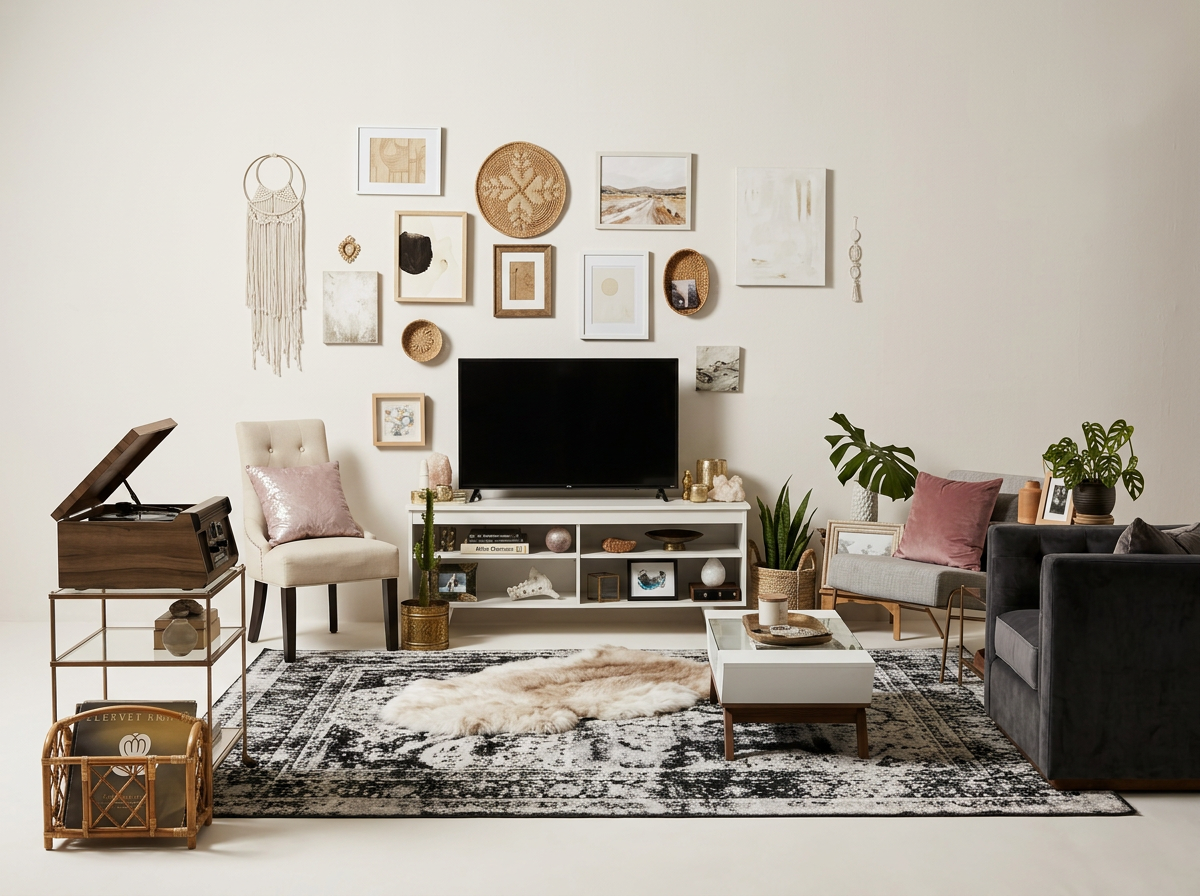
Layered art walls are having a real moment right now, and for good reason. That "collected over time" look feels warm, personal, and like an actual home instead of a catalog. But it goes wrong fast, and the difference between a gallery wall that works and one that looks chaotic usually comes down to four things.
Whether you're building a wall around an original or a print, here's how to layer art in your space without it turning into visual noise.
Start with a loose vision for the space
Before you start hanging or leaning anything, get a general vision for the room. It doesn't need to be super specific. It could be a color palette (four or five colors you're going to stick with). It could be a theme, like nature, or animals, or western, or coastal. It could be a mood, like calm and soft, or bold and energetic.
The point is not to lock yourself into a rigid plan. The point is to have a filter for what belongs. When everything you add passes through the same loose vision, the room feels intentional even when the pieces are wildly different sizes, styles, and mediums.
Let cohesive framing do the heavy lifting
This is the single fastest way to make a wall of mismatched art feel like it belongs together: use frames that either match each other or complement each other.
Matching frames (all black, all natural wood, all white) create a lot of instant cohesion. If the frames are the same, the art can be doing very different things and it will still read as one wall.
Complementary frames give you a little more freedom. Think two or three finishes that go together (natural wood, black, and brass, for example), spread throughout the arrangement. That's more collected and less matchy.
Either way, framing is doing most of the work. If you want a shortcut for making a chaotic wall feel intentional, this is it.
Mix textures and styles
The layered look works best when there's real variety. A big colorful abstract next to a small black and white photograph. A textured woven piece next to a smooth oil painting. Something realism-y next to something completely abstract.
If everything you have is loud, the wall is going to feel like it's yelling at you. Add neutral pieces to give the eye somewhere to rest. If everything is quiet, add one piece with real color or size to give the arrangement a heartbeat.
The mix is what makes it interesting. Matching sizes and styles is what makes a room look like a hotel lobby.
Actually layer things (not just hang them)
Layering doesn't only mean hanging pieces close together on a wall. Some of the best-looking art moments happen when you physically layer pieces on a surface.
Lean a big painting against the wall on a console table. Set a smaller framed piece in front of it, overlapping. Add a small ceramic or a stack of books nearby. That propped-up look is way more forgiving than trying to hang everything precisely, and it feels lived in instead of curated to death.
You can also lean art on a mantle, a floating shelf, or straight against a wall on the floor for oversized pieces. Some art was never meant to be centered and hung.
Don't take it too seriously
The biggest thing I want to tell you is this: don't overthink it. The rooms I love the most are the ones that clearly weren't built from a checklist. A painting that leans slightly. Something that doesn't quite match but the person who lives there obviously loves. That's what makes a home feel like yours.
Layered art works because it looks like real life. Give yourself permission to try things, move them around, and change your mind.
Browse originals and prints for your next layering project.
Further reading: How to Choose Art for Your Home.
Frequently Asked Questions
-
The center of the piece should sit around 57 to 60 inches from the floor. If the art is going over furniture, leave 6 to 12 inches between the top of the furniture and the bottom of the frame.
-
Roughly two-thirds to three-quarters the width of the couch. Anything smaller looks accidental. If you're using a gallery wall instead of a single piece, the whole arrangement should follow that same two-thirds rule.
-
No. Matching frames create the strongest cohesion, but two or three complementary finishes (like natural wood, black, and brass) can feel more collected. The point is that the framing should look intentional, not random.
-
A gallery wall is a specific type of layered art (multiple framed pieces close together on a wall). Layered art is broader and includes leaning pieces on surfaces, propping art on shelves, or mixing hanging with leaning.